
The NVPC Test is the Guardian of Modern Manufacturing
Non-Viable particle count (nvpc) : nvpc test procedure
In high-stakes manufacturing—from life-saving drugs and delicate vaccines to advanced microchips—the invisible can often pose the greatest risk. A tiny speck of dust, a microscopic fiber, or a skin flake can spoil an entire batch of medicine or lead to a critical failure in components. This is where the NVPC Test (Non-Viable Particle Count) comes in. It is not just a specialized scientific procedure; the NVPC test is a vital tool that confirms a workspace is genuinely “clean.” It ensures that air quality meets the extremely high standards necessary for creating safe, effective, and reliable products.
Section 1: Decoding the NVPC Test
What is a “Non-Viable Particle”? To understand the test, we must first define the enemy: the particle.
Non-Viable: This means non-living. These are not bacteria or mold (which are living), but inanimate contaminants like mineral dust, lint, hair, metal fragments, or aerosol droplets.
Particle Count: This involves measuring and counting how many of these non-living contaminants exist in a specific volume of air, usually one cubic meter (m^3). In short, the NVPC Test measures the concentration of dust and debris in a controlled environment to determine its cleanliness level.
The Sacred Space: Cleanrooms
The NVPC test is mainly performed in Cleanrooms. These are specially designed spaces aimed at minimizing contamination.
Industry
Why Clean Air Matters
- Pharmaceuticals & Biotech: Clean air prevents contamination of sterile products (injectables, eye drops) that must be entirely free of foreign matter to protect patients.
- Electronics & Aerospace: Tiny dust particles can lead to short circuits, etch defects on microchips, or compromise the integrity of satellite components.
Section 2: The Equipment—A Window into the Invisible
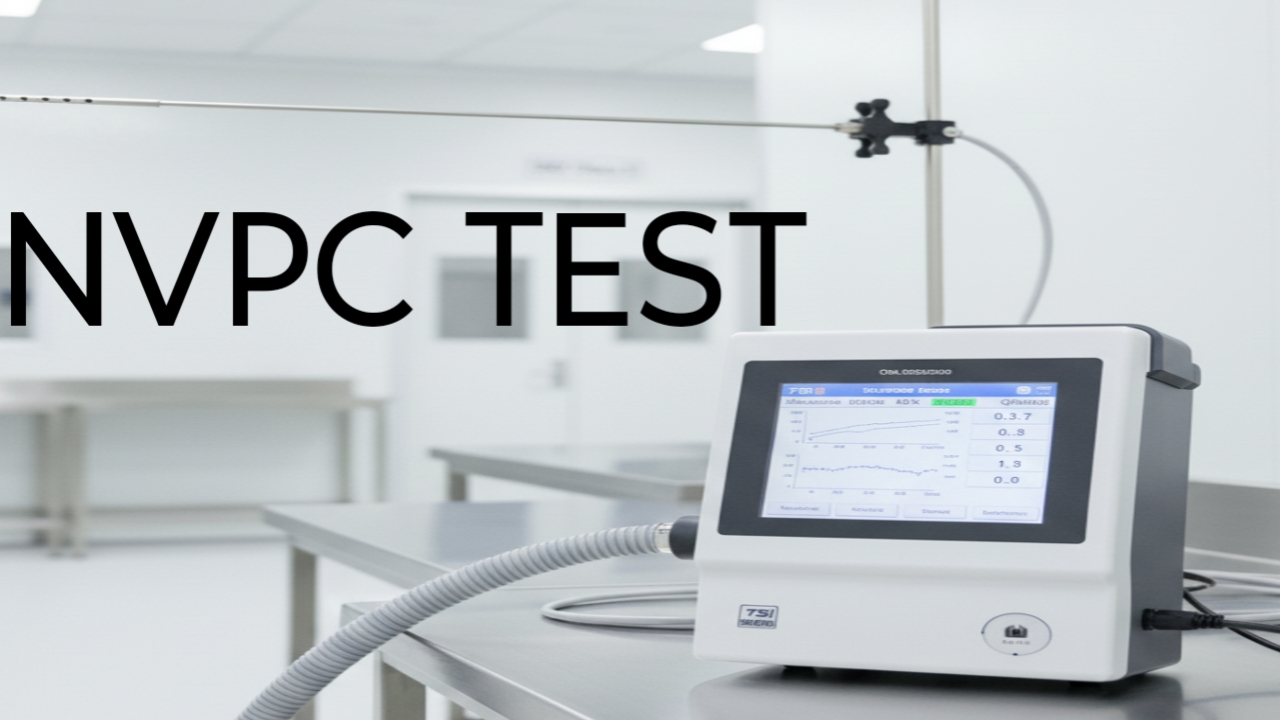
The NVPC test relies on an instrument that can literally see and count what the human eye cannot: the Light Scattering Airborne Particle Counter (LSAPC), often just called the Particle Counter.
How the Particle Counter Works
- Air Intake: The machine uses a special isokinetic probe (a nozzle that ensures air flows into the sensor at the same speed it was moving in the room) to draw a precisely measured volume of air (typically one cubic foot or 28.3 liters per minute).
- The Laser Beam: Within the counter, the sampled air passes through a focused laser beam.
- Light Scattering: When a tiny particle enters the beam, it scatters light in all directions—like dust motes visible in a sunbeam. The amount of light scattered correlates directly with the particle’s size.
- Detection and Counting: An advanced optical sensor measures this scattered light and converts the pulse into an electronic signal. The machine counts the pulses and sorts the particles into different size categories (e.g., 0.5 μm, 5.0 μm) based on the signal strength.
- Data Reporting: The result is instantly reported, usually as the number of particles per cubic meter (m^3) of air. This technology allows technicians to detect particles as small as 0.1 micrometers (μm), which is 700 times smaller than the average human hair!
Section 3: The Rules and The Classification System
The NVPC test follows a global standard: the ISO 14644-1 Standard. This standard not only mandates the test but also defines the classification system for cleanrooms worldwide.
The Key Guiding Standard: ISO 14644-1
This standard creates a numerical classification system from ISO Class 1 (the cleanest, used for advanced microelectronics) to ISO Class 9 (standard room air). The most common classes in the pharmaceutical sector are ISO 5, ISO 7, and ISO 8.
ISO Cleanroom Class Contamination Level Example Application (Pharma)
- ISO 5 (Grade A/B) Extremely Clean Aseptic (sterile) filling operations.
- ISO 7 (Grade C) Very Clean Preparation of materials for sterile products.
- ISO 8 (Grade D) Clean Handling of clean components before final sterilization.
Test Conditions: At Rest vs. Operational
A Cleanroom’s air quality is fundamentally different when empty compared to when it contains personnel. The ISO standard requires testing in two scenarios:
- “At Rest” Condition: The room is complete, the air handling system is functioning, but no personnel are present. This checks the mechanical cleanliness and design of the room itself.
- “Operational” Condition: The room is fully functioning with the specified number of personnel present, performing their routine tasks. This is the real-world test, with the contamination caused by humans included.
The Gold Standard: Particle Limits (Per m^3 of Air)
The test passes or fails based on whether the number of particles is below the maximum allowed limit set by the ISO class. The two main particle sizes counted are:
ISO Class (At Rest) | Max Particles ≥ 0.5 μm (Per m^3) | Max Particles ≥ 5.0 μm (Per m^3)
Max Particles ≥ 0.5 μm (Per m^3) | Max Particles ≥ 5.0 μm (Per m^3)
ISO 5 | 3,520 | 29
ISO 7 | 352,000 | 2,930
ISO 8 | 3,520,000 | 29,300
*Note: For the highest cleanliness levels (ISO 5), counting 5.0 μm particles is often used for monitoring, but the classification criteria in the latest standard may primarily focus on the 0.5 μm size.
Section 4: Human-Friendly Impact—Beyond the Numbers
The NVPC test is not just red tape; it is crucial for patient and consumer safety.
- The Role of Gowning: The largest source of particles in a cleanroom is the human body. Every skin cell or fiber shed increases the count. A failed NVPC test often indicates that the gowning procedure (wearing special suits, masks, gloves, and boots) or the air change rate (ACH) of the ventilation system needs immediate improvement.
- Continuous Monitoring: In critical areas (like ISO 5), the NVPC test is frequently conducted. This enables manufacturers to quickly identify issues—such as a door opening, a faulty filter, or a tear in a protective suit—and take immediate corrective action, safeguarding millions of products.
- The Certification Process: A successful NVPC test leads to a Cleanroom Certification. This certificate is legally required and confirms that the facility operates safely and is prepared to produce sterile or sensitive materials, building trust with regulators and the public.
In conclusion, the NVPC test is the scientific foundation of modern, sensitive manufacturing. It turns the invisible threat of airborne dust into measurable, manageable data, ensuring that the products we use are safe, uncompromised, and meet the highest quality standards.
FAQs-nvpc test
1.nvpc full form
Non-Viable particle counter.
1 thought on “The NVPC Test is the Guardian of Modern Manufacturing”