
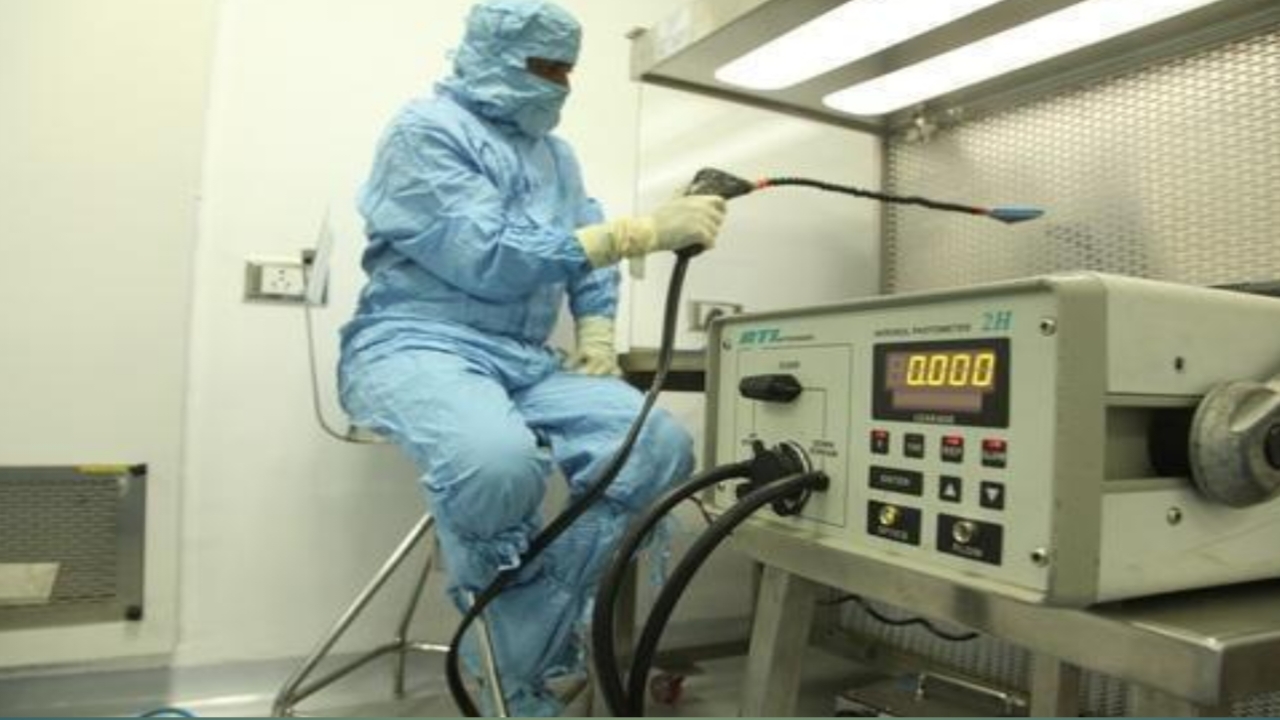
Filter Integrity Test Procedure in Pharma Industry
The Guarantee of Sterility: Requirements, Equipment, and Step-by-Step
GuideIn pharmaceutical manufacturing, particularly for life-saving sterile products like injections and vaccines, the assurance of sterility is crucial. Many drugs are too sensitive to be sterilized by heat. Instead, they undergo Sterilizing Grade Filtration, in which they pass through ultra-fine filters with pores typically 0.2 um in size-about 400 times smaller than a human hair-that physically trap all bacteria.
But what if there is an invisible crack or flaw in this critical filter?
This is where FIT comes in: the Filter Integrity Test, a scientific procedure mandated to ensure that the filter is 100% sound and integral.
Section 1: Regulatory Requirements and Timing-The “Why”
The FIT is a non-destructive test required worldwide by regulatory agencies, such as the FDA and EMA, for ensuring product safety.
1.Timing Requirements
This test needs to be conducted several times for each batch in order to ascertain filter integrity throughout the process:
Checkpoint Name, Timing-When is it performed?, Regulatory Purpose
Pre-Use Post-Sterilization (PUPSIT),“After the filter has been sterilized (e.g., autoclaved) but before the drug liquid is filtered.” To confirm the sterilization process did not physically damage the filter.
Post-Use Integrity Test,Immediately After the entire drug batch has been filtered.,To certify that the filter remained integral throughout the entire production run. This is the definitive proof required for batch release.
2. Requirements for Accuracy
The test shall be conducted using validated methods and automated equipment so as to obtain results that are precise, repeatable, and directly comparable with the manufacturer’s established minimum bubble point pressure or maximum forward flow rate.
Section 2: Equipment Used (The “How”)
The FIT depends on precisely calibrated, automated machinery to reduce human variability and ensure accuracy.
1. Automated Integrity Tester
It is the main device in the testing system and serves as its “brain.”
- Function: It provides precise control over test gas application, usually filtered air or nitrogen, and accurate pressure change and extremely low gas flow rate measurement.
- Requirements: include that the machine is calibrated and programmed regularly with specific Pass/Fail Criteria provided by the filter manufacturer.
2. Filter Housing and Cartridge
The filter cartridge is mounted in a secure manner inside a steel housing, which, in turn, is coupled to the Automated Tester via gas inlet and outlet ports.
3. Wetting Liquid
- Material: Usually Water for Injection (WFI) or the solvent in which the drug will be formulated.
- Purpose: The filter needs to be completely wetted before the test; this wetting will activate the critical surface tension barrier on which the integrity test principle is based.
Section 3: The Forward Flow Test Procedure
The most widely used automated method is the Forward Flow Test, which depends on the principle of Diffusion.
Step 1: Filter Preparation (Wetting is Key)
- Wetting: Liquid is passed through the filter for a specific period to saturate it. This ensures that all the pores are filled. The surface tension of the liquid will be the only resistance to the test gas.
- Stabilization: The liquid is subsequently drained from the upstream side, leaving the wetted filter ready for the application of the gas.
Step 2: Applying the Test Pressure
The test is conducted at a pressure below the actual Bubble Point pressure, typically about 80% of the Bubble Point pressure.
- Why Sub-Bubble Point Pressure? Since the pressure is less than the bubble point, the test gas is not able to physically displace the liquid from the pores and create bubbles. Instead, the pressure pushes the gas to be dissolved into the liquid occupying the pores and then diffuse to the downstream side.
Step 3: Measuring the Flow Rate
- Flow Measurement: After the pressure has stabilized, the automated tester measures the Total Forward Flow Rate-the total quantity of gas passing downstream-for a given period, for instance, 5-10 minutes.
2.Components of Flow: The total measured flow rate has two components:
- Diffusion: the small, expected, and acceptable flow of gas which dissolves and diffuses through the wetted pores.
- Mass Flow (Leak): Any extra, unacceptable flow of gas escaping directly through a dry spot, a crack, or a faulty seal.
Step 4: The Pass/Fail Decision
- Comparison: The measured Forward Flow Rate is instantly and automatically compared against the Maximum Allowable Flow specified by the filter manufacturer.
- Result:
- PASS: If the measured flow rate is below the maximum allowable limit the filter is considered Integral.
- FAIL: If the measured flow rate is ABOVE the maximum allowable limit, the filter is Non-Integral; that is, a structural breach is present.
Section 4: Final Action and Documentation
1. Documentation (The Audit Trail)
For every test the automated tester conducts, a full documented report is created. The report is required and must include:
- Date, Time, and Operator
- Filter Identification (Lot/Serial Number)
- Test parameters (Pressure, Time)
- Measured Flow Rate
- The definitive Pass or Fail result
This report is a legal requirement and is filed as a permanent part of the Batch Production Record to prove sterility to regulators.
2. Action on Post-Use Failure
If the critical Post-Use Integrity Test Fails, the following are the absolute consequences:
- The entire batch of drug product is immediately considered Non-Sterile.
- The batch must therefore be Rejected, not released to the market because public safety has been breached.
Therefore, the Filter Integrity Test Procedure is the last and uncompromising scientific safeguard of whether a potentially lifesaving pharmaceutical product meets the highest standards of safety and quality.
FAQs
Q1. PAO का फुल फॉर्म क्या है?
A. PAO का फुल फॉर्म है Poly-Alpha-Olefin
Q2.PAO के बजाय पहले कौन सा पदार्थ इस्तेमाल होता था?
A. पहले इसके लिए DOP (Di-Octyl Phthalate) नामक पदार्थ इस्तेमाल होता था, लेकिन सुरक्षा और पर्यावरण कारणों से अब PAO का उपयोग किया जाता है।
Q3. PAO टेस्ट में पास/फेल का मानदंड क्या है?
A. फ़िल्टर के नीचे (downstream) PAO लीक की मात्रा, फ़िल्टर के ऊपर (upstream) डाली गई सघनता के $0.01\%$ से अधिक नहीं होनी चाहिए।
Related topic:-The NVPC Test is the Guardian of Modern Manufacturing