
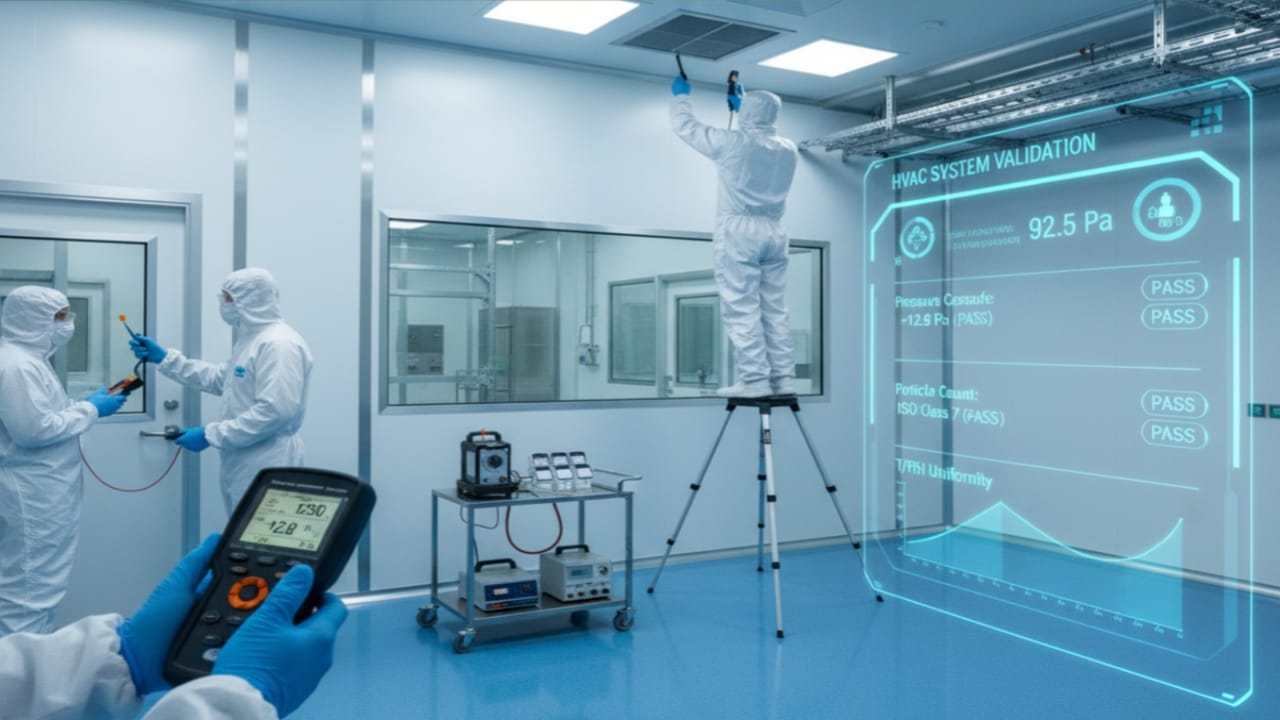
The HVAC Validation Protocol: Ensuring Cleanroom Integrity from Start to Finish
The Lifeline: Understanding Why HVAC Validation Matters
In any highly regulated environment—be it pharmaceutical manufacturing, surgical theaters, or advanced microelectronics—the HVAC (Heating, Ventilation, and Air Conditioning) system is more than just a climate control unit. It is the single most critical utility for contamination control.
HVAC Validation is the documented process of proving that this system can consistently and reliably maintain the precise environmental conditions required for product quality and patient safety. If the validation fails, the entire manufacturing operation stops. It is the bedrock of Good Manufacturing Practice (GMP).
- The validation journey is broken down into four essential qualification phases:
- Phase Focus Goal
- DQ Design Qualification Verification that the design meets the required standards and user needs.
- IQ Installation Qualification Confirmation that the system is built and installed correctly according to the design.
- OQ Operational Qualification Testing the system’s functional capacity across its full operating range.
- PQ Performance Qualification Proving long-term consistency under real-world, dynamic operating conditions.
The most important, hands-on work—the actual testing—occurs during the OQ and PQ phases. Here are the core tests that prove an HVAC system is fit for purpose.
The Core Performance Tests: What, Why, and How
An HVAC system typically undergoes nine primary tests to achieve qualification. These tests fall into three categories: Air Movement, Filtration Integrity, and Environmental Control.
Group 1: Air Movement and Pressure Control
1. Air Flow Velocity and Air Changes Per Hour (ACH)
What it is: This test measures the speed of the air exiting the supply diffusers and calculates how many times the entire volume of air in the room is replaced per hour (ACH).
Why it’s Critical: Sufficient air velocity and high ACH rates are the primary mechanism for diluting and purging internally generated contaminants (like dust or human skin cells). Every cleanroom classification (e.g., ISO 7 or GMP Grade C) has a specific minimum ACH requirement (often \mathbf{\geq 20} per hour).
Key Equipment:
Thermo-Anemometer (or Vane Anemometer): Used to measure air velocity in Feet Per Minute (FPM) or meters per second (m/s).
2. Differential Pressure Test (The Pressure Cascade)
What it is: This test measures the static air pressure difference (\Delta P) between adjacent controlled rooms or zones.
Why it’s Critical: The pressure cascade ensures that air always flows from the cleaner area (held at a positive pressure) toward the less clean area, creating an invisible air barrier. If this pressure fails, contaminants can ingress when doors are opened.
Acceptance Criteria: Typically, \mathbf{10 to 15 \text{ Pascals } (\text{Pa})} differential pressure must be maintained between zones.
Key Equipment:
Digital Manometer: A highly accurate instrument designed to measure minute differences in static pressure.
Group 2: Filtration Integrity and Air Purity
3. HEPA Filter Integrity Test (PAO/DOP Leak Test)
This is perhaps the single most critical test for cleanroom environments using High-Efficiency Particulate Air (HEPA) filters.
What it is: A test to confirm that the HEPA filter media, its housing, and the surrounding gaskets are completely free of leaks, pinholes, or seal bypasses.
Why it’s Critical: Even a microscopic pinhole allows thousands of particles to bypass the filtration system, rendering the expensive filter useless. The test uses a challenge aerosol, usually
Poly-Alpha Olefin (PAO).
Procedure: A known concentration of PAO aerosol is injected upstream. A specialized probe then scans the downstream face and perimeter of the filter.
Acceptance Criteria: Measured penetration must be less than \mathbf{0.01\%} of the upstream challenge concentration.
Key Equipment:
Aerosol Generator (PAO Generator): Creates the uniform, measurable PAO aerosol.
Aerosol Photometer: Measures the concentration of the aerosol that penetrates or leaks past the filter media or seals.
4. Non-Viable Particle Counting (NVPC)
What it is: The direct measurement of airborne particulate cleanliness, counting the total number of particles in the air, typically sized at \mathbf{0.5 \mu m} and \mathbf{5.0 \mu m}.
Why it’s Critical: This is the ultimate test that verifies the room meets its required cleanroom classification (e.g., ISO 5, 7, etc.). It must be conducted under both:
At-Rest: Equipment running, no personnel present.
In-Operation (Dynamic): Routine work and personnel flow are active (the worst-case condition).
Key Equipment:
Laser Particle Counter: A dedicated instrument that uses laser light scattering to accurately count and size airborne particles.
Group 3: Environmental Stability and Uniformity
5. Air Flow Pattern Study (Smoke Test)
What it is: A visual test to demonstrate and record the directional movement of air, particularly in critical zones requiring unidirectional (laminar) flow.
Why it’s Critical: The air must flow smoothly, sweeping contaminants away from the product and out of the room. This test visually identifies areas of turbulence (eddies) or dead spots where contaminants can accumulate. The entire process is usually recorded.
Key Equipment:
Smoke Generator (Fogger): Produces a non-contaminating, highly visible fog to trace the air path.
Video Camera: Required for objective and permanent documentation.
6. Temperature and Relative Humidity (RH) Uniformity
What it is: The test confirms that the temperature and RH set points are not only achieved but are also uniform across the entire volume of the controlled area.
Why it’s Critical: Product stability (especially drugs) is highly sensitive to fluctuations in heat and moisture. This test ensures there are no “hot spots” or high-humidity zones that could compromise product integrity.
Key Equipment:
Calibrated Data Loggers (Thermo-Hygrometers): Placed at strategic locations (low, middle, and high levels) across the room to record T/RH data simultaneously over an extended period (e.g., 72 hours).
7. Recovery Test (Clean-up Time)
What it is: This test measures the time required for the room to return to its specified At-Rest particle level after a transient contamination event.
Why it’s Critical: It proves the system’s ability to rapidly recover its cleanliness following a minor disruption (like material transfer or a momentary lapse in door closure). It demonstrates the system’s resilience.
Acceptance Criteria: Recovery time is typically specified in the protocol, often required to be \mathbf{\leq 15 to 20 { minutes}.
Key Equipment:
Laser Particle Counter: Used to continuously monitor the particle concentration decay over time.
8. System Functionality and Control Checks
What it is: Verifying the proper operation of all critical controls, interlocks, and alarms programmed into the Building Management System (BMS) or local control panels.
Why it’s Critical: This ensures that if the system moves outside its required parameters (e.g., pressure drops below 10 { Pa} or temperature spikes), the system generates the correct alarm or triggers a programmed interlock to protect the process.
9. Viable/Microbial Monitoring
What it is: Determining the concentration of living microorganisms (bacteria and fungi) in the air and on surfaces.
Why it’s Critical: Essential for sterile and aseptic processing (Grade A and B areas). While HEPA filters remove particles, this test focuses on biological contamination.
Key Equipment:
Active Air Samplers: Machines that pull a measured volume of air over a prepared nutrient medium (agar plate).
Settle Plates: Petri dishes left exposed for a set duration to passively capture viable organisms settling from the air.
Summary of Essential Validation Equipment
Test Parameter Primary Test Equipment Key Function
- Airflow & ACH Thermo-Anemometer Measures air velocity (FPM) at outlets.
- Differential Pressure Digital Manometer Measures static pressure difference between areas (in Pa).
- Filtration Integrity Aerosol Generator & Photometer Creates challenge aerosol; measures leakage through filter/seals.
- Particulate Counting Laser Particle Counter Counts and sizes non-viable particles in the air.
- T/RH Uniformity Calibrated Data Loggers Records temperature and humidity at various points over extended time.
- Air Flow Pattern Smoke Generator Creates fog to visually trace airflow path.
- Microbial Monitoring Active Air Sampler Quantifies airborne biological contamination.
By executing these nine rigorous tests and maintaining detailed documentation, a facility establishes the fundamental guarantee that its HVAC system will consistently provide a safe, clean, and controlled environment for product manufacturing. It’s a massive effort, but it’s non-negotiable for compliance and quality!
Very good information 😃